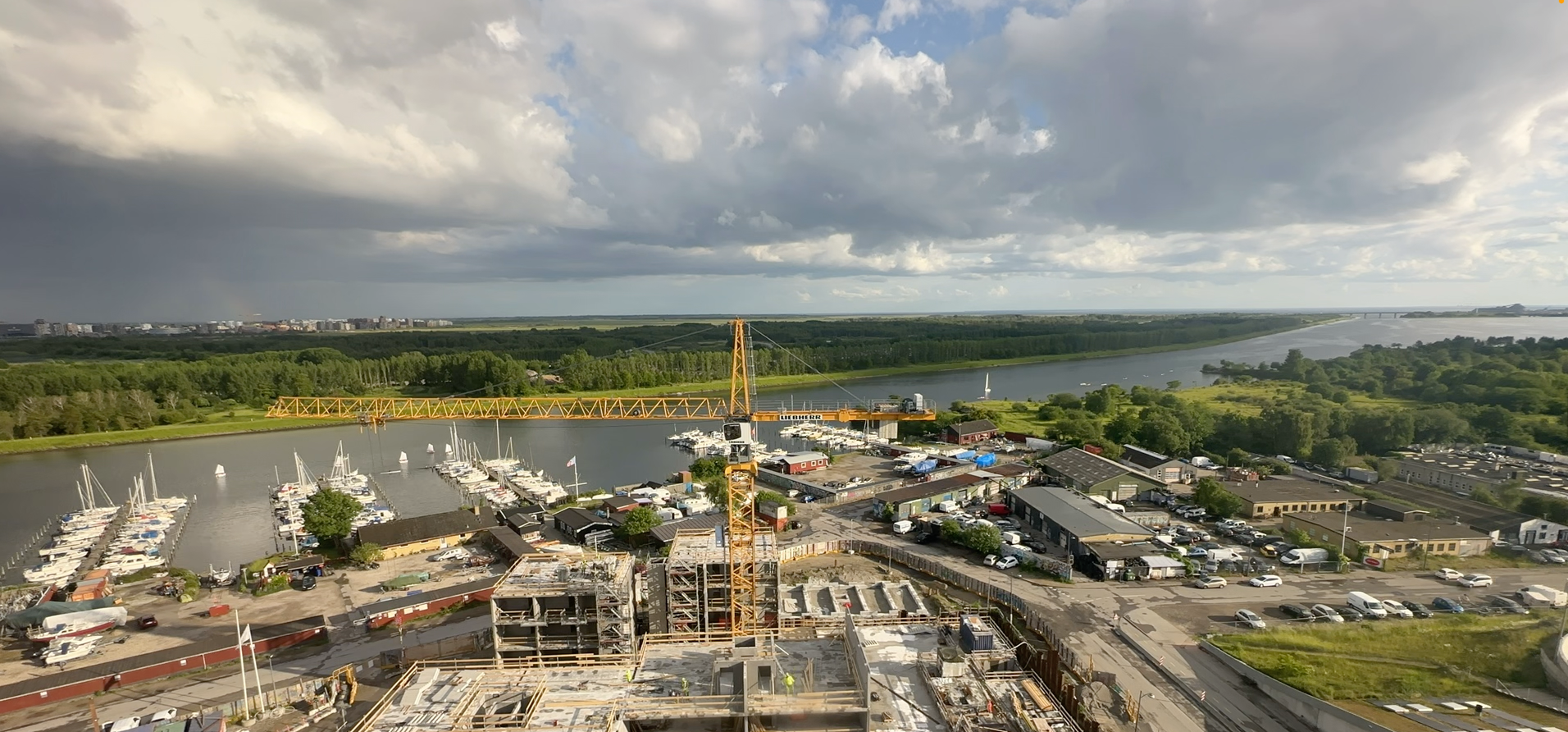
Checklist: Before you hire a crane operator for your construction project
7 key points to clarify before booking a crane operator for your construction project — from certificates and crane model experience to pricing, safety and references.
Checklist: Before You Hire a Crane Operator for Your Construction Project
The crane is on site. The schedule is tight. Now you just need the right operator — and this is exactly where many projects run into trouble. A poor match between operator and task doesn’t just cost hours. It costs money, progress and, in the worst case, safety.
This checklist helps you ask the right questions before you book a crane operator — whether you contact us at KSR CRANES or another supplier.
1. Clarify crane type and certification requirements
Not all certificates cover all cranes. In Denmark, the requirements for crane operator certification are set out in the Executive Order on occupational health and safety training (Executive Order no. 1978 of 27/10/2021).
In short:
- Basic crane training (kranbasis) is mandatory for everyone operating cranes covered by the certificate rules.
-
Truck‑mounted cranes and mobile cranes over 8 tm require specific modules:
- Over 8 tm up to and including 30 tm: Basic crane training + “Mobile cranes over 8 tonne‑metres”.
- Over 30 tm: Basic crane training + “Mobile cranes over 8 tonne‑metres” + “Mobile cranes over 30 tonne‑metres”.
- Tower cranes and other fixed cranes over 8 tm require Basic crane training + “Tower cranes and fixed cranes over 8 tonne‑metres”.
In practice, you can think in three main categories:
| Category (practical) | Crane type | Required training | Typical tasks |
|---|---|---|---|
| Truck‑mounted crane up to 30 tm | Truck crane / loader crane (HDS) with max. load > 8 tm up to and including 30 tm | Basic crane training + “Mobile cranes over 8 tonne‑metres” | Loading/unloading, lighter prefab installation, logistics |
| Mobile crane / crawler crane over 30 tm | Mobile crane with ballast, including crawler cranes, > 30 tm | Basic crane training + “Mobile cranes over 8 tonne‑metres” + “Mobile cranes over 30 tonne‑metres” | Heavy lifts, bridge sections, large prefabricated elements |
| Fixed crane / tower crane | Tower cranes and other fixed cranes > 8 tm | Basic crane training + “Tower cranes and fixed cranes over 8 tonne‑metres” | High‑rise construction, element installation, steel structures |
Note: In the industry people often talk about “A/B/E certificate”, where fixed cranes/tower cranes correspond roughly to A, mobile cranes over 30 tm to B, and truck‑mounted cranes up to around 28–30 tm to E. This is a practical shorthand — the legally binding requirements always follow the specific modules and the tonne‑metre thresholds in the regulations.
Check: Can the supplier document that their operator holds: Basic crane training and the correct modules (8–30 tm, > 30 tm, tower/fixed crane) for the exact crane type and maximum load on your site? A valid and correct certificate is a legal requirement — not a bonus.
2. Ask about experience with the specific crane model
A certificate proves that the operator is allowed to operate a crane. It does not prove that he knows your specific crane.
There is a big difference between running a standard Liebherr EC‑B with full automation and a Kroll K1030F with 36‑tonne tip capacity, where the operator has to handle load inertia manually. Models like the Kroll F‑series (K1030F, K830F, K630F, K430F) require a deep understanding of the machine’s specific load curve and wind behaviour.
Check: Ask for concrete references for the exact crane model on your site — not just “tower crane experience in general”.
3. Clarify response time and flexibility
Construction sites don’t wait. When an operator calls in sick at 05:30 on Monday morning, you need a replacement — not an agency that “will get back to you within 48 hours”.
With specialised providers like KSR CRANES, start‑up is often possible within 24 hours, even in urgent cases. This is because of a small, dedicated team where everyone knows each other’s strengths and availability.
Check: What response time does the supplier guarantee? Do they have a concrete plan for emergency replacement?
4. Understand the difference between price and cost
The hourly rate is only part of the calculation. What really costs money on a construction site are mistakes, delays and safety issues.
Here’s what the wrong operator can typically cost you:
- One day of delay on an element installation project
- One safety incident: site shutdown, report to the Labour Inspection and potential sanctions
- One week with an operator “learning the machine”: lost progress for the whole team
The real difference between two suppliers rarely lies in the hourly rate — but in how quickly, safely and consistently the work gets done.
Check: Evaluate the supplier on experience, reliability and ability to deliver from day one — not just on price.
5. Check what is included in the service
Price is only one element. Two suppliers may have the same hourly rate but deliver very different services.
The difference is in the details:
- Valid certificates — verified and up to date
- Experience with the specific crane model — not just general experience
- Personal protective equipment (PPE) — ready from day one
- Insurance coverage — liability and workers’ compensation
- Reliable attendance — the same operator, not a parade of temps
- Substitute arrangement — what happens in case of sickness or holidays?
- Communication with site management — the operator understands the signalman’s instructions
Check: Get it in writing. A supplier who cannot specify these points is most likely a general temp agency — not a specialist crane operator provider.
6. Assess the safety culture
Safety is not a PowerPoint presentation. It’s behaviour that shows up in practice:
- Does the operator inspect the crane before the first lift of the day?
- Will he refuse a lift if wind conditions are unstable?
- Is he used to working with a signalman over radio?
- Does he know the wind limits for the specific crane model?
An experienced operator says “no” to an unsafe lift. An inexperienced one says “yes” — and that is what costs millions.
Check: Ask the supplier directly: “How do you ensure that your operators follow safety procedures — even when the site management is pushing the schedule?”
7. Verify references from similar projects
A good supplier should be able to provide concrete references — not just “many satisfied customers”, but named projects with contact persons.
Check: Ask for 2–3 references from projects similar to yours (same crane type, similar scale, same region). Call them. It takes 10 minutes and can save you weeks of frustration.
The complete checklist
Print this and use it next time you hire a crane operator:
| # | Item | Status |
|---|---|---|
| 1 | Crane type and required modules (8–30 tm, > 30 tm, tower/fixed) are clarified | ☐ |
| 2 | Supplier has documented experience with the specific crane model | ☐ |
| 3 | Response time and emergency replacement are agreed | ☐ |
| 4 | Price is specified (incl. extras, insurance, PPE) | ☐ |
| 5 | Scope of service is confirmed in writing | ☐ |
| 6 | Safety culture and procedures have been discussed | ☐ |
| 7 | At least 2 references from similar projects obtained | ☐ |
Conclusion
The cheapest operator is rarely the cheapest solution. An operator who knows your crane, works safely and delivers from day one — that’s the difference between a project that runs smoothly and one that is constantly behind.
At KSR CRANES, we provide only experienced and certified crane operators with documented experience on the crane types used in Denmark today. No temps. No generalists. Only specialists.
Need a crane operator for your next project?
Call us on +45 23 26 20 64 or
send an enquiry here.
Sources: Executive Order no. 1978 of 27/10/2021 on occupational H&S training · Danish Working Environment Authority – Examples of certificate requirements · AT‑guidance 1.9.4 on crane operator certificates
This text is a simplified overview of the applicable rules and does not replace official legislation, executive orders or case‑specific advice from the authorities.
Need a safe and efficient crane operation setup?
If you need reliable crane operators for your next project, we are ready for a short, no-obligation conversation.